







The No-Zones of a Tractor Trailer
In 2024, 5,340 people died in crashes involving large trucks, and 62% of them were people in cars and other passenger vehicles — not the truck occupants (IIHS Fatality Facts 2024). That imbalance is the whole story of a tractor-trailer crash. A large truck can weigh 20 to 30 times what your car weighs, and when the two meet, physics decides the outcome before anyone touches a brake. Getting truckers to blast the horn is a fond childhood memory for a lot of us. Sharing a lane with one is not the place for that nostalgia. The single most useful thing you can know is where a big rig’s driver cannot see you — the areas the federal government calls the No-Zones.
Key Takeaways
- A tractor-trailer has four No-Zones — front, rear, driver’s side, and passenger side — and the passenger-side blind spot is the largest of the four.
- FMCSA’s own guidance is blunt: large trucks have “huge blind spots — or No Zones — around the front, back and sides of the vehicle.”
- Trucks travelling at highway speeds can need up to the length of two football fields to stop, so the front No-Zone is a braking problem as much as a visibility one.
- Being in a blind spot does not forfeit your claim — California’s pure comparative negligence rule reduces an award by your share of fault; it does not erase it.
What is a No-Zone on a tractor-trailer?
The No-Zones of a tractor-trailer are called that because cars and other vehicles should avoid entering or lingering in these areas around the truck as much as possible. They are not a courtesy zone or a rule of thumb invented by trucking companies — they are the areas the Federal Motor Carrier Safety Administration identifies as the places a commercial driver structurally cannot see, no matter how careful or well trained that driver is.
FMCSA puts it plainly on its Our Roads, Our Safety guidance: “Large trucks and buses have huge blind spots — or No Zones — around the front, back and sides of the vehicle.” The word doing the work in that sentence is huge. A passenger car’s blind spot hides another car for a moment during a lane change. A tractor-trailer’s blind spots can hide an entire vehicle for the length of a freeway on-ramp.
There is a simple field test that works from the driver’s seat of your own car: if you cannot see the truck driver’s face in their side mirror, they cannot see you. It is not a perfect rule, but it is the one that keeps people alive, and it costs nothing to apply.
Where are the four No-Zones on a big rig?
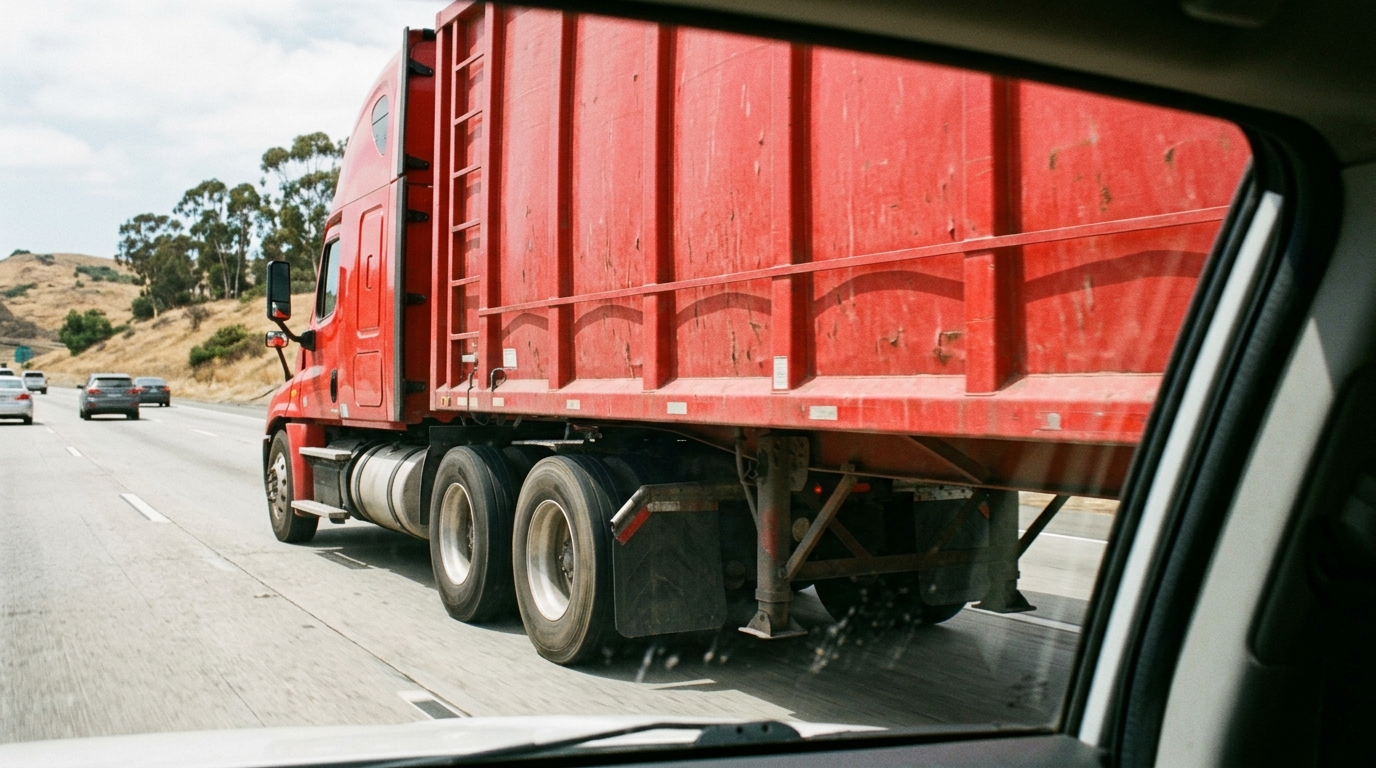
The first is the area at the front of the tractor-trailer. Despite the driver sitting up so high, there is a limit to how much they can see over the front end of the truck, and their visibility is obstructed for a meaningful distance ahead of the bumper. Cars in this zone are not visible to the truck driver, and being that close to the front of a loaded rig is dangerous on its own terms given how long the truck needs to slow down or stop.
On the opposite side is the rear No-Zone — the area behind the trailer that is a blind spot to the driver. A tractor-trailer has no interior rearview mirror; there is a trailer where the back window would be. Cars travelling behind a truck should leave substantial space, because if the truck brakes suddenly, the vehicle behind risks more than a rear-end collision. Passenger cars sit far lower than a trailer deck and can become wedged underneath it. That failure mode — underride — is severe enough that it has driven a sustained federal campaign for stronger underride guards.
The third No-Zone runs along the driver’s side of the truck. Drivers in this area are not visible to the trucker, so if the truck needs to change lanes or swerve, anyone sitting there is at serious risk.
The fourth falls on the passenger side, and it is the largest of the four. The cab sits on the left, so the driver’s sightline across to the right is obstructed in a way it simply is not on their own side. The No-Zones on either side should be avoided at all costs, but the practical takeaway is asymmetric: if you must pass a truck, do it quickly, and do it on the driver’s side, where the blind spot is significantly smaller.
Why are a truck’s blind spots so much more dangerous than a car’s?
Because a blind spot is only half of the problem. The other half is that the vehicle which cannot see you also cannot stop. FMCSA’s Share the Road Safely materials warn that a truck travelling at highway speed can need up to the length of two football fields to come to a complete stop. A car’s blind spot is a visibility issue with a braking escape hatch. A truck’s blind spot removes the escape hatch.
Weight compounds it. IIHS notes that large trucks can weigh 20 to 30 times as much as passenger cars — a “large truck” being anything with a gross vehicle weight rating over 10,000 pounds. That ratio explains the fatality split above: of the 5,340 people killed in large-truck crashes in 2024, 17% were truck occupants and 62% were in passenger vehicles. The person in the smaller vehicle absorbs the energy.
Height compounds it again. Bumper heights do not line up, crumple zones do not meet, and a car that would survive an equivalent impact with another car can slide under a trailer instead of striking it. None of this is the fault of the person in the car. It is the built-in asymmetry of sharing a road with a vehicle that outweighs you by an order of magnitude.
Who is liable when a truck changes lanes into you?
The instinct after a blind-spot crash is to assume the driver simply did not see you and that is that. In California, “I didn’t see them” is not a defense — a commercial driver has a duty to know where their No-Zones are and to clear them before moving. Failing to do so is negligence, not bad luck.
Liability rarely stops at the driver. The motor carrier can be vicariously responsible for its driver and directly responsible for how it hired, trained, and supervised them, and for whether it pressured a schedule that made a careless lane change likely. Depending on the facts, the broker, the shipper, the company that loaded the trailer, or a maintenance contractor who left a mirror or camera unrepaired can share responsibility. Our guide to the parties who can be held liable in a California truck accident walks through how those layers stack.
That breadth matters commercially as much as legally. A tractor-trailer carries far higher policy limits than a private car, and the layers of potential defendants often carry their own coverage. Identifying every responsible party early is frequently the difference between a claim that covers a lifetime of care and one that runs out at a single policy limit. Our truck accident lawyers build the defendant list before the evidence ages out.
What if I was partly at fault for being in the No-Zone?
Expect the insurer to make this argument. It is the first move in nearly every blind-spot file: you knew the No-Zone existed, you sat in it, so this is on you. It is worth understanding why that argument is weaker than it sounds.
California follows pure comparative negligence under Li v. Yellow Cab Co. (1975). Your compensation is reduced in proportion to your share of fault — it is not eliminated. A driver found 30% responsible for lingering alongside a trailer still recovers 70% of their damages. Even at 80% fault, a California plaintiff recovers the remaining 20%. There is no threshold at which partial fault wipes out a claim.
So the fight is about percentage, not permission, and percentage is evidentiary. Dashcam footage, the truck’s own side-camera data, mirror-adjustment records, and the driver’s training file routinely move that number. Insurers open with a high fault percentage because it is cheap to assert and expensive to disprove — unless someone preserves the evidence quickly.
Common mistakes after a blind-spot truck crash
- Giving a recorded statement to the carrier’s insurer before you have spoken to a lawyer — the questions are built to fix your fault percentage early.
- Accepting that “I was in his blind spot” settles the question of fault. Under California law it does not.
- Waiting for the truck’s electronic logging device and control-module data to be produced voluntarily. Retention schedules are measured in months; a spoliation letter is what stops the clock.
- Treating a two-year statute of limitations as the planning horizon. The evidence window closes long before the filing window does.
- Assuming the driver is the only defendant, and settling with the carrier before the broker, shipper, or loader has been investigated.
- Posting about the crash, your injuries, or your recovery on social media while a claim is open.
How Does Compass Law Group Help After a No-Zone Truck Crash?
Blind-spot cases are won on evidence that has a shelf life. We send preservation letters to the carrier and its insurer immediately, so the electronic control module data, the electronic logging device records, and the side- and dash-camera footage are locked down before routine retention schedules erase them. We identify every potentially responsible party — driver, carrier, broker, shipper, loader, maintenance contractor — before anyone settles with the first one who offers.
We handle truck cases across California from our offices in Los Angeles and beyond, including dedicated Los Angeles truck accident and Beverly Hills truck accident teams. Where a No-Zone collision has taken a life, our wrongful death attorneys handle the claim alongside the truck case. There is no fee unless we win.
Tractor-Trailer No-Zone Crashes — Key Statistics
| Figure | Source (year) |
|---|---|
| 5,340 people died in large-truck crashes | IIHS Fatality Facts, Large Trucks (2024) |
| 62% of those killed were passenger-vehicle occupants | IIHS Fatality Facts, Large Trucks (2024) |
| 17% were truck occupants; 19% pedestrians, cyclists or motorcyclists | IIHS Fatality Facts, Large Trucks (2024) |
| Large trucks can weigh 20–30× a passenger car | IIHS (2024); “large truck” = GVWR over 10,000 lb |
| Trucks at highway speed can need up to two football fields to stop | FMCSA, Share the Road Safely |
| Deadline to file in California: 2 years from injury | Cal. Code Civ. Proc. §335.1 |
Steps to Take After a Tractor-Trailer Accident
- Call 911 and get a police report. A CHP or local traffic collision report anchors the timeline that everything later is measured against.
- Photograph the truck’s DOT number, license plate, trailer number, and the carrier name on the door — before the rig leaves. Tractors and trailers get reassigned quickly.
- Photograph the vehicles in their final positions, all four sides of the truck, skid marks, and the lane configuration. Position evidence disappears the moment the road reopens.
- Get medical attention the same day, even if you feel fine. Adrenaline masks soft-tissue and head injuries, and a gap in treatment becomes an argument that you were not really hurt.
- Collect names and numbers for every independent witness. In multi-lane freeway crashes, witnesses scatter and are effectively unfindable a day later.
- Do not give a recorded statement to the carrier’s insurer, and do not accept an early offer.
- Contact a truck accident lawyer quickly enough that a preservation letter reaches the carrier while the ELD and camera data still exist.
Q: What is the No-Zone on a tractor-trailer?
The No-Zone is the set of blind spots around a large truck where the driver cannot see you. FMCSA states that “large trucks and buses have huge blind spots — or No Zones — around the front, back and sides of the vehicle.” If you cannot see the truck driver’s face in their side mirror, they almost certainly cannot see you.
Q: Which side of a big rig has the largest blind spot?
The passenger side. A tractor-trailer’s right-side blind spot is far larger than the left because the cab sits on the left and the driver’s sightline across the cab is obstructed. That is why, when you must pass, passing on the driver’s side exposes you to a smaller blind spot for less time.
Q: Is it my fault if I was driving in a truck’s blind spot?
Not automatically. California follows pure comparative negligence under Li v. Yellow Cab Co. (1975), so you can recover damages even if you were partly at fault — your award is simply reduced by your share. A trucking insurer will argue you “chose” to sit in the No-Zone; that argument is a negotiating position, not a rule of law.
Q: How long do I have to file a truck accident claim in California?
Generally two years from the date of injury under California Code of Civil Procedure §335.1. Claims against a public entity are far shorter — typically six months. Evidence in trucking cases disappears much faster than the deadline, which is why the filing window is the wrong thing to plan around.
Q: What evidence matters most in a blind-spot truck crash?
The truck’s electronic control module and electronic logging device, the carrier’s dashcam and side-camera footage, the driver’s hours-of-service records, and the mirror-adjustment and training file. Much of it is subject to routine retention schedules measured in months, so a spoliation letter should go out early.
Q: Can I sue the trucking company, or only the driver?
Usually both, and often more. The carrier can be vicariously liable for its driver and directly liable for negligent hiring, training, or supervision. Depending on the facts, the broker, shipper, loader, or a maintenance contractor may also share responsibility.

Get Your Free Consultation Today
Injured in Los Angeles, California? Compass Law Group fights for full compensation — No Win, No Fee. Call now or submit your case online for a free, confidential review.