






Fatal Semi-Truck and Work Truck Crash on Highway 99 Near Manteca: What CHP Records Show
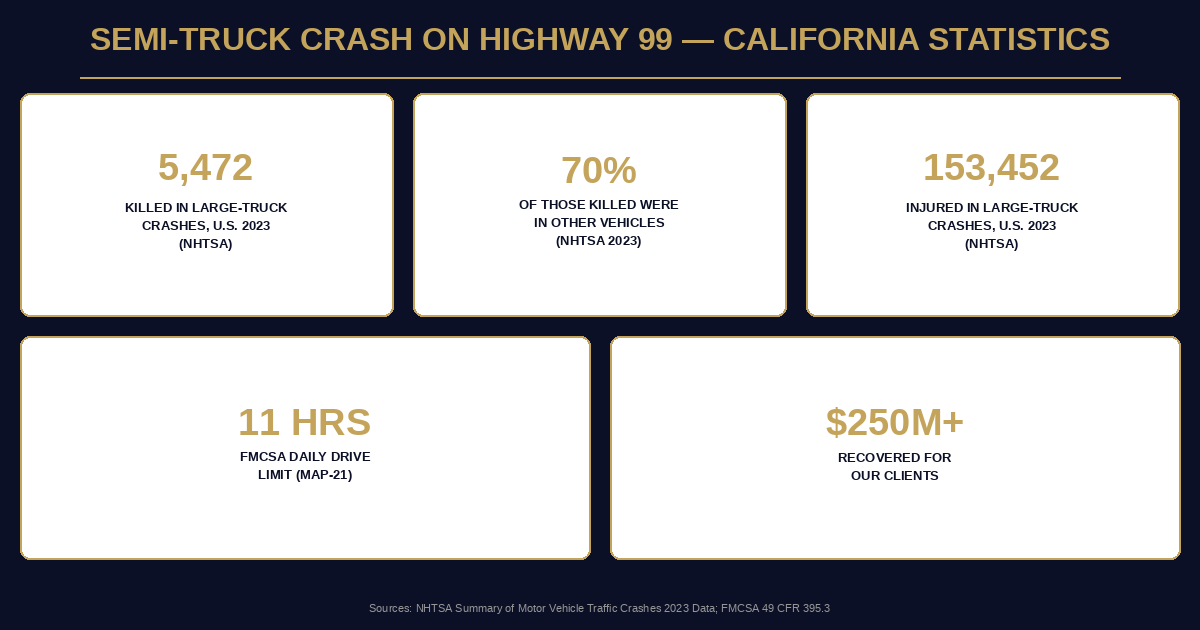
Federal crash data shows why a collision between a big rig and a smaller work truck so often ends the way this one did: of the 5,472 people killed in traffic crashes involving large trucks in 2023, 70 percent were occupants of other vehicles, not the truck (National Highway Traffic Safety Administration, Summary of Motor Vehicle Traffic Crashes: 2023 Data). Late on Sunday, August 16, 2026, that pattern repeated on northbound Highway 99 near the Highway 120 East connector in the Manteca area of San Joaquin County, where one occupant of a white work truck was killed.
Key Takeaways
- The California Highway Patrol fatal incident feed logged the crash at approximately 11:27 p.m. on August 16, 2026, on State Route 99 North at State Route 120 East, describing it as “big rig truck versus white work truck.”
- Two occupants had to be extricated from the overturned work truck. One occupant died. No identification had been confirmed in public reporting as of August 18, 2026.
- Published accounts of the crash sequence conflict, and a second tractor-trailer may have struck debris afterward, rupturing a fuel tank and spilling roughly 20 gallons of diesel.
- Because the sequence determines which driver and which carrier investigators scrutinize, the cause should not be treated as settled until CHP releases its collision report.
A fatal multi-vehicle collision involving a white work truck and at least one big rig occurred late Sunday night on northbound Highway 99 near the Highway 120 interchange in the Manteca area of San Joaquin County. One occupant of the work truck was killed. The circumstances leading to the initial collision remain under investigation.
What Do We Actually Know About the Highway 99 Crash Near Manteca?
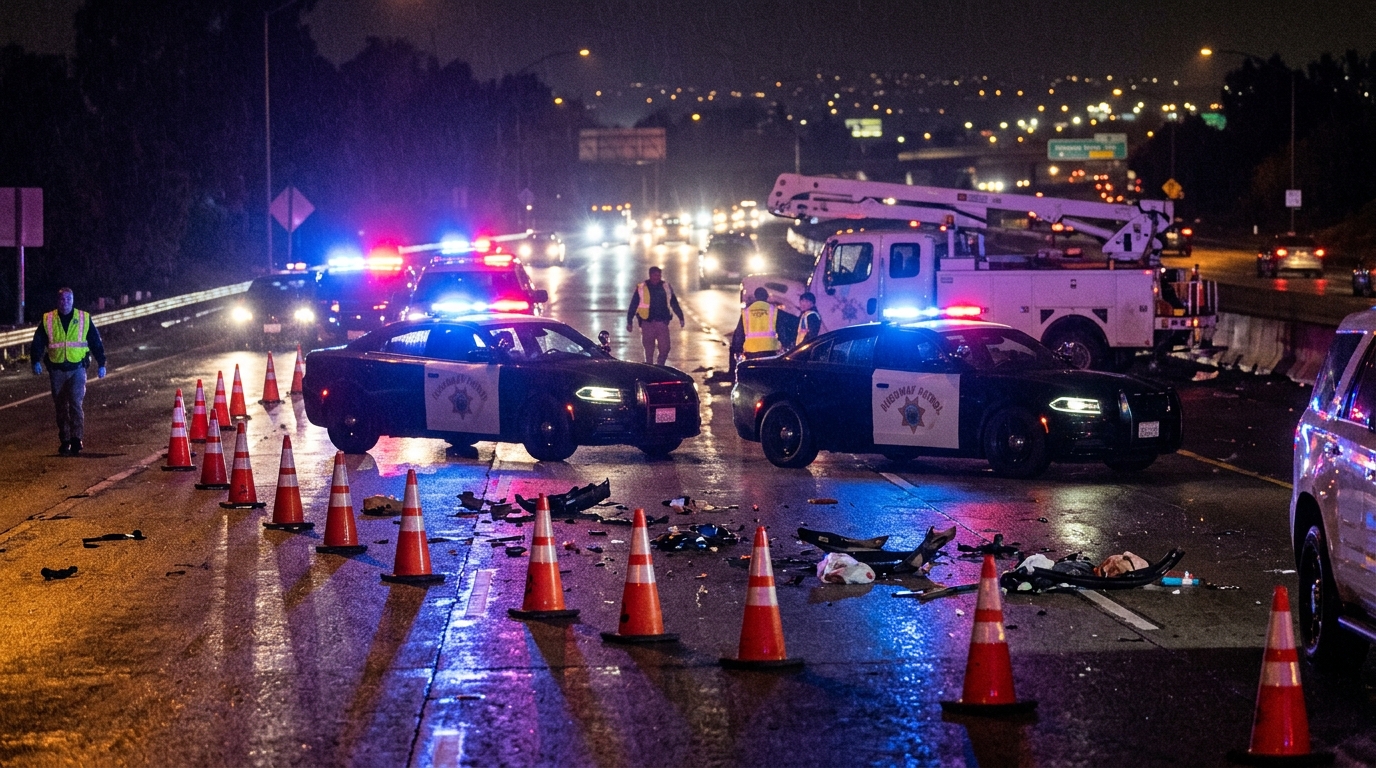
The confirmed facts come from the California Highway Patrol’s own fatal incident log, which recorded the collision on northbound State Route 99 at the State Route 120 East connector at roughly 11:27 p.m. on Sunday, August 16, 2026. The initial log entry describes the vehicles involved in blunt terms: “big rig truck versus white work truck,” followed by a note that a big rig was pulled over in the slow lane.
Incident-log reporting indicates the work truck left the roadway and overturned onto its roof, and that fire crews extricated two occupants from it. One of those occupants suffered fatal injuries. Some secondary reporting describes the person who died as a passenger rather than the driver, but that detail should be treated as provisional until CHP or the San Joaquin County Medical Examiner confirms it.
Debris was scattered across lanes after the impact, prompting a traffic break from the Austin Road area. A tractor-trailer hauling a refrigerated trailer loaded with approximately 38,000 pounds of frozen food blocked the roadway, and Caltrans was called to assist with lane closures. The number four lane was closed just north of the State Route 120 East connector, and reporting indicates the remaining closure cleared at approximately 4:12 a.m. on August 17.
What is not established is why the first impact happened. No cause, no citation, and no assignment of fault had been made public. That gap matters, and it is the reason this article describes a sequence of events rather than asserting one.
Why Do the Published Accounts of This Crash Disagree?
There are two materially different versions of how this collision unfolded, and the difference is not cosmetic.
One account holds that the work truck overturned first, blocking Highway 99, and that a semi-truck then struck the already-overturned vehicle. In that telling, the work truck’s loss of control is the initiating event and the big rig is a secondary impact.
A more detailed reconstruction drawn from the CHP incident log describes the reverse: a big rig collided with the white work truck, the impact drove the work truck off the roadway and onto its roof, and a second tractor-trailer later struck debris left in the traffic lanes, damaging its fuel tank and leaking an estimated 20 gallons of diesel from a roughly 100-gallon tank. That version implies three vehicles and two separate big rigs, not two vehicles total.
Those are not two descriptions of the same thing. In the first, a commercial driver encountered an obstruction that was already there. In the second, a commercial vehicle caused the initial impact. The first version points investigators toward the work truck; the second points them toward the first big rig and its carrier. Anyone reading early coverage of a fatal crash should understand that this kind of divergence is common in the first 48 hours, when reporting is assembled from a live incident log rather than a finished investigation.
The responsible position is the one CHP itself is in: the sequence is unresolved. We are not going to tell a grieving family which driver was at fault based on a discrepancy we can see in the public record.
What Does an Evidence Tow Signal After a Fatal Truck Crash?
Reporting reconstructed from the CHP log indicates that investigators requested an evidence tow for at least one vehicle. An evidence tow means a vehicle is preserved rather than released — held so that investigators can examine it after the scene is cleared.
In a fatal commercial-vehicle collision, that examination typically looks at a specific set of physical questions:
- Braking systems — whether the service brakes were in adjustment and functioning across all axles.
- Tires and wheel components — tread depth, inflation, and evidence of a failure before impact.
- Lighting and reflective equipment — whether the vehicle was visible to others, which matters enormously in a crash just before midnight.
- Electronic control module data — the engine and ECM records that can show road speed, throttle position, and braking in the seconds before impact.
- Damage and contact patterns — the physical geometry that establishes which vehicle struck which, and at what angle.
- General mechanical condition — deferred maintenance that a carrier’s own inspection records may or may not reflect.
An evidence tow does not, by itself, establish fault, negligence, criminal conduct, or a coming prosecution. It signals that the physical evidence is considered material enough to preserve. In our experience handling California truck accident claims, that preserved evidence is frequently the difference between a case built on speculation and one built on measurable fact — particularly when the ECM data contradicts a driver’s account.
Was This Crash in Stockton or Manteca?
Early accident-reporting sites placed this collision in Stockton. The location in the CHP log — northbound Highway 99 at the Highway 120 East connector — sits in the Manteca area of San Joaquin County, south of Stockton proper. The Stockton label most likely reflects the CHP communications center that processed the call, and the Stockton Fire Department response, rather than the crash site itself.
This is not pedantry. Venue and jurisdiction follow geography. So do the responding agencies whose records a family will later need to request, and the county court where a claim would eventually be filed. Getting the location wrong at the outset sends people to the wrong agency for the wrong report.
For families in San Joaquin County, the practical point is that the crash occurred on a stretch of Highway 99 that carries heavy commercial traffic between the Central Valley and the Bay Area, at an interchange where northbound traffic merges from State Route 120. Our nearest office serves this corridor from Sacramento, roughly 45 miles north.
Who Can Be Held Responsible in a Multi-Vehicle Commercial Truck Crash?
When a crash involves two commercial vehicles, a work truck, and debris in live traffic lanes, responsibility is rarely a single name. California law allows liability to be apportioned among multiple parties, and in a collision structured like this one the candidates ordinarily include the driver of each commercial vehicle, the motor carrier that employed each driver, the owner of each vehicle if ownership and operation are separate, the entity responsible for loading a trailer, and any party whose maintenance failures contributed.
The second-impact element makes this more complex, not less. If a following tractor-trailer struck debris that a prior collision left in the roadway, questions arise about warning, visibility, following distance, and how quickly the hazard was reported and controlled. Those are separate factual inquiries from the first impact, and they can produce separate liability.
None of that can be resolved from an incident log. It requires the collision report, driver logs, carrier records, and often the preserved vehicles themselves. What families can do immediately is make sure that evidence is requested before it is lost — commercial carriers are not obliged to keep everything indefinitely, and some records have short retention windows. A Sacramento truck accident lawyer can send a preservation demand while an investigation is still open.
What Are a Family’s Legal Options After a Fatal Truck Collision?
Under California Code of Civil Procedure section 377.60, a wrongful death claim may be brought by specified surviving family members, including a spouse, domestic partner, children, and in some circumstances other dependents. That claim is distinct from a survival action brought on behalf of the person who died. Where a fatal crash also injured other occupants, those injury claims proceed alongside it.
Deadlines are strict, and they are not the same for every defendant. If a public entity’s conduct is implicated — road design, signage, or hazard response, for example — a government claim must be presented far sooner than the general personal injury deadline. Missing that window can end an otherwise sound claim before it starts.
Serious non-fatal injuries in a crash of this kind commonly include traumatic brain injury from roof-crush and rollover forces, spinal trauma, and crush injuries requiring extrication — the kind of harm that reshapes a household’s finances permanently. Our Sacramento wrongful death attorneys and brain injury team handle these claims together, because in a fatal multi-occupant crash they are usually the same case.
We have written before about how these investigations unfold in similar Central Valley and freeway collisions, including a fatal semi-truck sideswipe in Fresno County, a 210 Freeway big rig wrongful death case, and a big rig fire on the I-5 where a ruptured fuel system drove the severity of the outcome. The recurring lesson across all of them is that the physical evidence degrades faster than the legal process moves.
Source: Compass Law Group | Large-Truck Crash Data (NHTSA 2023)
How Does Compass Law Group Help After a Highway 99 Truck Crash?
Our role in the first days after a fatal commercial collision is narrow and practical: preserve what can still be preserved, and get the family accurate information instead of speculation.
That means requesting the CHP collision report as soon as it is available, sending spoliation letters to every identified carrier so driver logs, ECM data, dashcam footage, inspection records, and the vehicles themselves are not released or repaired, identifying the carriers and their insurers through DOT filings, and retaining accident reconstruction where the sequence is genuinely contested — as it is here. We also handle the insurer contact, so a grieving family is not giving statements to an adjuster in the same week as a funeral.
California’s comparative fault rules mean that even a family facing an argument about their own driver’s conduct may still recover. A disputed sequence is a reason to investigate, not a reason to assume there is no claim. Understanding how fault is determined in California collisions is often the first thing families want explained, and it is a conversation we have at no cost. Statewide, commercial vehicle crashes remain a persistent share of serious harm on California roads — a pattern we examined in more depth in our analysis of the leading causes of traffic fatalities in California.
Steps to Take After a Fatal Truck Accident in San Joaquin County
- Request the CHP collision report. It is the authoritative account and supersedes early incident-log reporting. Ask for the report number and the investigating officer.
- Do not give a recorded statement to any insurer yet. Adjusters call early precisely because the facts are still unsettled and families are not yet informed.
- Write down what you know while it is fresh. Who called you, when, what agency responded, which hospital, and the names of anyone who spoke to you at the scene.
- Preserve the vehicle’s status. If a vehicle is in an evidence hold or a tow yard, do not authorize release, repair, or salvage.
- Identify witnesses and video quickly. Nearby commercial dashcams and business cameras along the corridor are typically overwritten within days.
- Keep every document. Medical records, funeral costs, employment records, and any correspondence from a carrier or insurer.
- Get the deadlines confirmed in writing. They differ by defendant, and a public-entity claim runs on a much shorter clock.
Frequently Asked Questions
Where exactly did the August 16, 2026 Highway 99 crash happen?
The California Highway Patrol fatal incident log places the collision on northbound State Route 99 at the State Route 120 East connector at approximately 11:27 p.m. on August 16, 2026. That location is in the Manteca area of San Joaquin County, south of Stockton proper, although some early accident-reporting sites labeled it a Stockton crash because of the responding CHP communications center and fire department.
How many people were killed in the Manteca Highway 99 truck crash?
One occupant of the white work truck was killed. Fire crews extricated two occupants from the overturned vehicle, and one of them suffered fatal injuries. Some secondary reporting described the person who died as a passenger, but that had not been confirmed by CHP or the San Joaquin County Medical Examiner, and no identification had been released in public reporting as of August 18, 2026.
Why do reports disagree about how the crash happened?
Two conflicting sequences have been published. One says the work truck overturned first and was then struck by a semi-truck. A more detailed reconstruction of the CHP incident log says a big rig struck the work truck, causing it to overturn, and that a second tractor-trailer later hit debris in the roadway and ruptured a fuel tank. The difference changes which driver and which carrier investigators would scrutinize, so the sequence should not be stated as fact until CHP releases its collision report.
Who can file a wrongful death claim in California?
Under California Code of Civil Procedure section 377.60, specified surviving family members may bring a wrongful death claim, including a spouse, domestic partner, children, and in some circumstances other dependents. That claim is separate from a survival action brought on behalf of the person who died. Where other occupants were injured in the same crash, their injury claims proceed alongside the wrongful death claim.
What evidence matters most in a commercial truck crash investigation?
Electronic control module data showing speed and braking, driver logs and hours-of-service records, carrier maintenance and inspection files, dashcam footage, and the physical damage patterns on each vehicle. Much of it sits with the motor carrier rather than with public agencies, and some of it has short retention periods, which is why a preservation demand early in an investigation matters more in truck cases than in ordinary collisions.
Does an evidence tow mean someone will be charged?
No. An evidence tow means investigators want a vehicle preserved for examination rather than released. It reflects the seriousness of a fatal collision and the value of the physical evidence. It does not by itself establish fault, negligence, criminal conduct, or an anticipated prosecution.
How long do families have to act after a fatal truck crash in California?
The general personal injury and wrongful death deadline in California is two years from the date of injury under Code of Civil Procedure section 335.1, but the deadline is not the same for every defendant. If a public entity may share responsibility, a government claim must be presented on a much shorter schedule. Because a multi-carrier crash can involve several potential defendants, the safest step is to have the applicable deadlines confirmed early rather than assumed.
Our thoughts are with everyone affected by this crash. We will continue to follow the investigation as CHP releases additional information.
This post is based on preliminary CHP incident-log reporting and secondary news accounts as of August 18, 2026. Details are subject to change as the investigation continues.

Get Your Free Consultation Today
Injured in Sacramento, California? Compass Law Group fights for full compensation — No Win, No Fee. Call now or submit your case online for a free, confidential review.
References
- California Highway Patrol fatal incident feed (SR-99 N / SR-120 E), August 16, 2026
- NHTSA, Summary of Motor Vehicle Traffic Crashes: 2023 Data (large trucks)
- Red, White and Blue Press — Fatal Multi-Vehicle Crash with Big Rig at SR-99, SR-120 in Manteca (Aug 17, 2026)
- California Code of Civil Procedure §377.60 (wrongful death standing)